- The ring gauge changes the surface-area-to-volume ratio: small gauges lose heat fast, large gauges carry strong thermal inertia.
- Pressure drop explains the draw: from 48 to 54 ring gauge, the cross-section grows by about 30%.
- A larger gauge raises the smoke-capacity ceiling, but does not equal better flavor.
- Excessive air intake dilutes the tobacco concentration: 44–46 gauges can offer a more concentrated flavor instead.
- Fast-paced occasions call for 42–48; slow night tasting for 52–56; above 60, demand tight packing.
Cigar Ring Gauge and Its Technical Correspondence with Burn Time and Smoke Volume
In the world of cigars, many people's understanding of Ring Gauge still stops at the superficial physical dimension of "thickness." But in my more than ten years of smoking experience, the ring gauge has never been a simple size parameter: it is a set of complex physical variables that directly determine the thermodynamic balance of combustion, the pressure drop of the airflow, and ultimately the quality of the smoke that reaches the lungs.
I still remember a muggy afternoon in 2015 in Havana, Cuba, when I tried to finish a small 42-ring-gauge cigar during a short break. Because the ambient humidity was extremely high, that slender cigar burned with unusual urgency between my fingers, like a burning match. I had assumed that a smaller body would deliver a lighter experience, but what I got was extremely high draw resistance paired with searing, almost acrid smoke. In that moment I realized that changing the ring gauge is, at its core, a redistribution of the ratio between heat and oxygen.
The Thermodynamics of Combustion: A Game of Surface Area and Mass
From the perspective of physics, a change in ring gauge directly alters the cigar's "surface-area-to-volume ratio."
When we talk about a 42-ring-gauge cigar, its mass is very small relative to its surface area. This means heat dissipates very quickly. If your puffing frequency is high, or the environment is dry, the cigar's burn line (Ash line) advances rapidly, because the tobacco per unit mass is oxidized by large amounts of oxygen in a short time.
Conversely, when I switched to a 56-ring-gauge wide cigar, the situation was completely reversed. The huge tobacco mass acts like a massive heat reservoir, capable of maintaining an extremely stable core combustion temperature. In those moments when I was accustomed to slow-paced tasting, large-ring-gauge cigars displayed astonishing stability—they would not suddenly cool at the burn line because of your occasional pause, nor would the whole cigar suddenly "run wild" because of a deep draw. This thermal inertia is a technical advantage that small-ring-gauge cigars can never provide.
Airflow Dynamics: Pressure Drop and Draw Feel
The effect of ring gauge on draw can be explained through the pressure drop in fluid mechanics.
The combustion channel of a cigar can be regarded as a non-uniform pipe. When the ring gauge increases from 48 to 54, the cross-sectional area of the channel increases by about 30%. This seemingly minor change leads to a dramatic drop in resistance during the draw.
I once made a very subjective yet extremely accurate comparison: when drawing on a classic 48-ring-gauge Vitola, you feel a "springy resistance" that lets the smoke create a subtle pressure in the mouth, better unlocking the oily richness of the tobacco. However, once you switch to 56 ring gauge, that resistive feel rapidly disappears, replaced by a smoothness close to "vacuum inhalation." This smoothness is a double-edged sword: it lets you easily obtain a large volume of smoke, but it also makes over-puffing extremely easy, allowing the combustion temperature to run out of control.
Smoke Volume: More Than Just an Increase in Size
Many people think that a larger ring gauge means more smoke, which is true, but not accurate enough. A more precise statement is that a larger ring gauge provides a higher "ceiling for smoke capacity."
By comparing common ring-gauge data, we can build an intuitive technical model:
| Ring Gauge | Estimated Burn Time (Medium Frequency) | Draw Resistance | Smoke Volume | Typical Characteristics |
|---|---|---|---|---|
| 42 | 25-35 minutes | Extremely high | Minimal | Extremely concentrated, suitable for a quick transition, but easy to overheat |
| 48 | 45-55 minutes | Medium | Medium | The classic balance point, the golden ratio of flavor and body |
| 52 | 60-75 minutes | Moderate | Full-bodied | The modern mainstream, offering excellent smoke performance |
| 56 | 80-100 minutes | Relatively low | Grand | Slow-paced enjoyment, suitable for large, deep puffs |
| 60+ | 120 minutes and above | Extremely low | Voluminous | Extremely strong visual impact, demanding the highest tobacco quality |
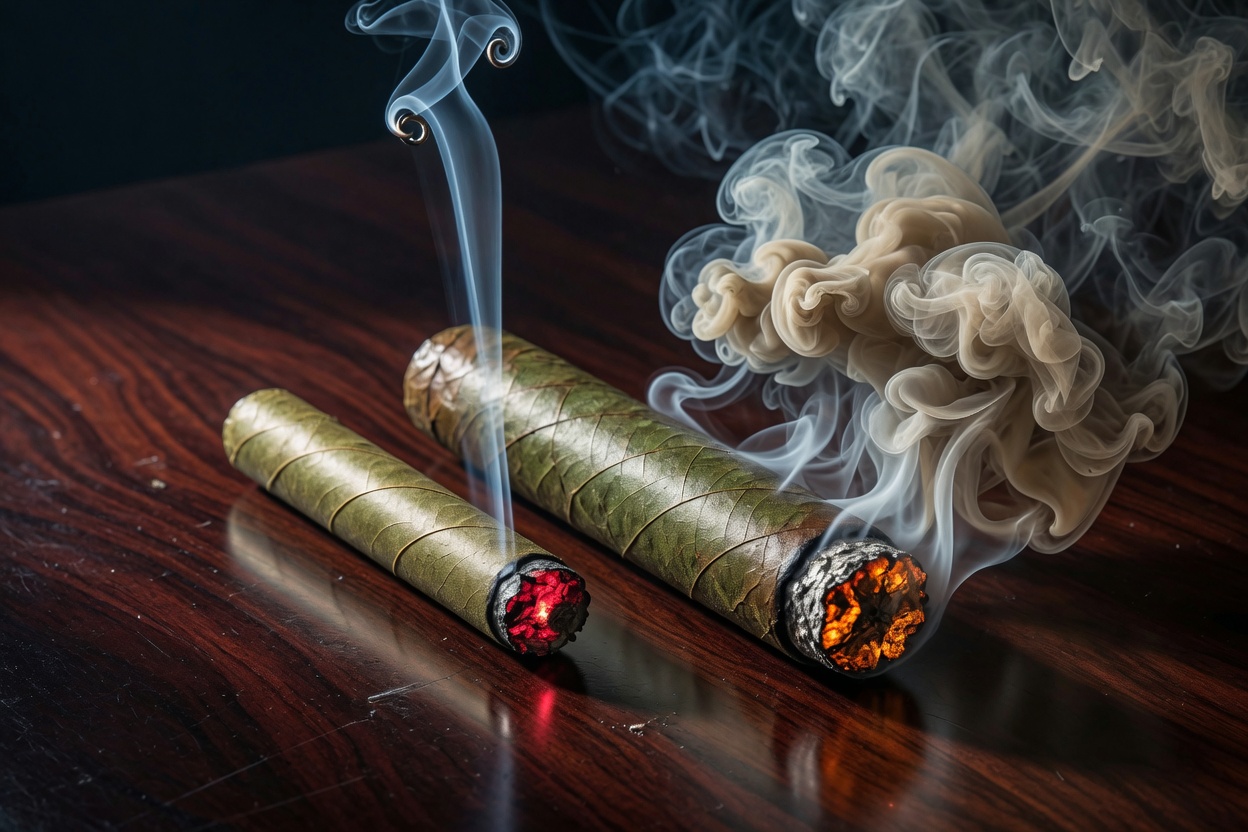
48 Ring Gauge
48 Ring Gauge
The classic balance point: springy draw, medium smoke, the golden ratio of flavor and body.
56 Ring Gauge
Wide-body stability: low draw, voluminous smoke flow, strong thermal inertia, ideal for slow, deep puffs.
When I switched from a 48-ring-gauge cigar to a 56-ring-gauge one, what I felt was not merely a doubling of smoke volume, but a change in "texture." The voluminous smoke flow brought by a large ring gauge can better carry the volatile oils in the tobacco, allowing each mouthful of smoke, as it lingers in the mouth, to cover a broader sensory area.
Concentration and Dilution: A Neglected Trap
Here is a technical misconception I must point out: a larger ring gauge does not always mean better flavor.
In practice, if you choose a cigar with an enormous ring gauge (such as 60) but a relatively low fill density, you will find that the smoke volume is astonishing, yet the flavor appears extremely "hollow." This is because the excessive air intake dilutes the concentration of tobacco particles. It is like vehicles driving on a broad highway: they may look imposing, but if the power is insufficient, they cannot deliver that compact impact.
Conversely, some meticulously crafted 44 or 46-ring-gauge cigars, thanks to their extremely high internal pressure and minimal smoke dilution, can often deliver a rich flavor that is almost "solidified." This concentrated quality is the soul that players chasing "smoke clouds" so often lose when they pursue large ring gauges.
Personal Practical Advice
Based on these physical characteristics, I have summarized a personal selection logic:
If you are in a fast-paced social setting, or only have a 30-minute gap, be sure to choose a cigar of 42 to 48 ring gauge. They give you the most concentrated flavor impact and will not make you feel embarrassed by burning too slowly.
If you are on a terrace late at night, wanting to enjoy an hour-long meditation by yourself, then 52 to 56 ring gauge is your ideal choice. With their stable heat and full-bodied smoke volume, you can more leisurely unpack the changes of each flavor layer.
As for those "giants" above 60 ring gauge, make sure you are facing a top-tier work with extremely tight packing; otherwise, what you will get is nothing but a meaningless, hollow smoke performance.
The ring gauge is not a number to show off: it is the precision interface through which you conduct thermodynamic exchange with the tobacco. Choose the right ring gauge, and only then have you truly mastered the rhythm of this art.