This article clarifies one thing: tobacco tar is not something pre-hidden in the leaf, but a product of high-temperature combustion chemistry.
The leaf supplies precursors, not a ready-made barrel of tar.
One reaction chain: heating, distillation, pyrolysis, combustion, secondary reactions, condensation.
Understanding tar composition by category is more useful than memorizing a falsely precise formula.
Low tar does not equal low harm; a filter does not equal filtered clean.
Health perspective: the tar index is a communication symbol, not a toxicity balance.
The True Origin and Formation of “Tar” in Tobacco Leaves
When many people hear the word “tar,” they instinctively picture a pool of black, sticky substance already stored inside tobacco leaves, “roasted” out once lit and inhaled into the lungs. This picture is intuitive, yet almost entirely wrong.
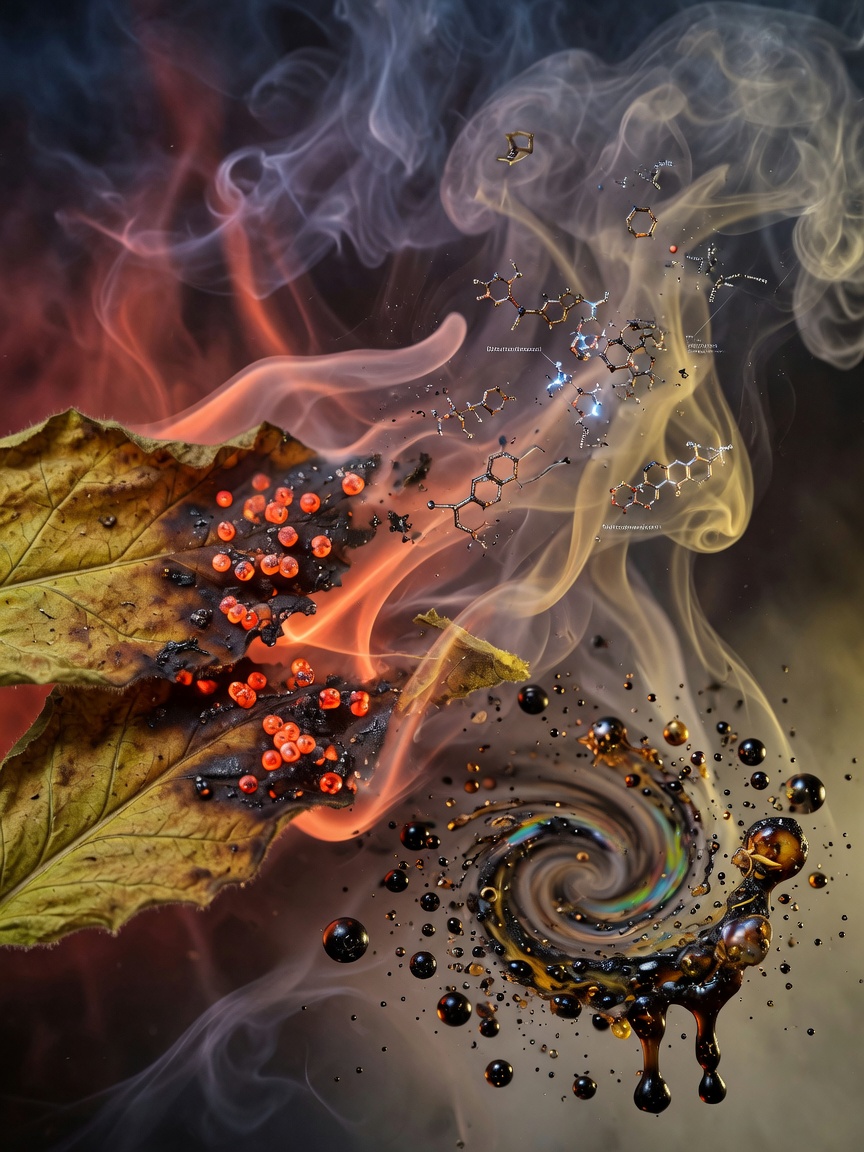
A more accurate statement is: there is no single native substance called “tar” in tobacco leaves. The tobacco tar spoken of in daily conversation, on packages, and in test reports is chiefly an extremely complex mixture newly generated from tobacco leaves (as well as paper, filters, additives, etc.) through combustion or incomplete combustion and high-temperature pyrolysis, then cooled and condensed, adsorbed onto particulate matter, collected, and analyzed. It is not “a drop of oil” grown in a tobacco field; it is the product inventory of a high-temperature chemical reaction.
Understanding this helps one see through two common types of rhetoric: one claims “natural tobacco leaves contain no chemical tar, so they are cleaner”; the other claims “low tar equals lower harm.” Both simplify “tar” into something that should not be simplified. The rest of this article proceeds in the order: definition → precursors → formation process → influencing factors → misconceptions → health implications.
---
1. First, Clarify: What Does the “Tar” People Talk About Actually Refer To?
1.1 “Tar” in Everyday Language
In public discourse, “tar” is often taken to mean:
• The yellow, sticky stuff on cigarette butts;
• The “smoke stains” on fingers and teeth;
• The number printed on packages, “tar content X mg”;
• One of the “two big harms” listed alongside nicotine.
These impressions are not entirely wrong — the smoke indeed contains large amounts of condensable organic matter and particles — but they conflate a measured index, sensory stains, and a chemical entity.
1.2 “Tar” in Smoke Chemistry and Testing Contexts
In mainstream cigarette smoke analysis, the common path is roughly:
1. A standard smoking machine smokes the cigarette according to a prescribed puffing profile;
2. A Cambridge filter pad and similar devices trap the particulate phase of mainstream smoke (Total Particulate Matter, TPM);
3. Water and nicotine are then subtracted from it, yielding the approximate quantity customarily called “tar.”
Therefore, the “tar content” on the label is closer to:
Under standard conditions, the mass in mainstream smoke particulate matter after subtracting water and nicotine.
It is an operational definition, not “nature contains a molecule called tar, and here is how many milligrams were measured.”
This implies three important things:
| Point | Meaning |
|---|---|
| Tar is a mixture | Hundreds and thousands of organic compounds + particle matrix; composition varies with conditions |
| Tar is a condition-dependent product | Change temperature, oxygen, puffing, and both its quantity and profile change |
| Tar is an index, not the whole picture | Many toxic substances are in the gas phase and are not necessarily all counted into “tar mg” |
1.3 Don’t Simply Equate It with “Road Tar”
Coal tar from petroleum processing, road asphalt, and tobacco smoke particulate matter may all look “black and sticky,” but their raw materials, formation pathways, and principal component profiles are not the same. Saying tobacco tar is “the same as what paves roads” is striking but not rigorous.
A more measured statement is: the particulate condensate produced by tobacco combustion contains polycyclic aromatic hydrocarbons (PAHs), phenols, heterocyclic compounds, and many other known or potentially harmful constituents, some of which overlap in category with other combustion products (such as soot and particulate organics in internal-combustion exhaust) — this is precisely one of the chemical bases of its health concern.
---
2. What Tobacco Leaves “Originally Contain”: Precursors, Not Tar
If a cigarette is likened to the fuel pack of a small burning reaction, the tobacco leaf supplies the fuel and reactants, not a ready-made “tar barrel.”
2.1 Main Plant Matrix
| Precursor Category | Rough Role | Relationship to Tar Formation (summary) |
|---|---|---|
| Cellulose, hemicellulose | Main cell-wall polysaccharides | At high temperature, pyrolysis yields intermediates such as levoglucosan, which further crack into carbonyls, furans, small-molecule hydrocarbons, and participate in smoke formation and secondary reactions |
| Lignin | Aromatic polymer | An important source of phenols, methoxyphenols, and part of aromatic structures |
| Starch and soluble sugars | Especially abundant in flue-cured tobacco | Participate in caramelization and Maillard reactions, contributing aroma as well as complex organic fragments and condensates |
| Proteins, amino acids | Nitrogen reservoir | Pyrolysis can form nitrogen-containing heterocycles, nitriles, amines, and related products; co-heating with sugars also follows the Maillard pathway |
| Nicotine and other alkaloids | Core addictive constituents | Part enters the smoke, part is transformed by pyrolysis; usually not called “tar,” but measured separately from tar |
| Polyphenols, organic acids, lipids, waxes | Metabolic and surface constituents | Affect color, irritation, aroma; contribute specific fragments during pyrolysis |
| Inorganics (potassium, chlorine, calcium, etc.) | Ash and catalytic environment | Affect combustion temperature, integrity, and smoldering behavior, indirectly changing organic conversion rates |
| Pesticide residues, heavy metals, and other exogenous materials | Undesired residues | Some may enter smoke or ash; not the “main body” of tar, but part of the risk picture |
2.2 There Is Also the “Non-Tobacco” Contribution
A cigarette is not pure cut tobacco:
• Cigarette paper and tipping paper: cellulose-based substrates plus burn additives/fillers, which also undergo pyrolysis;
• The filter: mainly traps part of the particulate phase; under normal smoking it usually does not “burn into a tar mainstay,” but its design changes the delivered amount;
• Casing and flavoring: sugars, humectants, flavors, etc. can change the pyrolysis product profile and subjective taste, and may also change the mass and composition of the particulate phase.
So the more precise question is not “does tobacco leaf contain tar,” but:
Under a specific temperature–oxygen–time pathway, how are these precursors decomposed and recombined, and condensed into the particulate mixture we measure?
---
3. An Overview of the Formation Process: A Reaction Chain from Heating to Condensation
One can imagine the burning zone of a cigarette as a moving miniature reactor: a glowing combustion cone at the front, pyrolysis and distillation zones behind it, and the airflow carrying products toward the filter and mouth. The stages below are described in order (in reality they overlap spatially).
Stage 1: Heating Up and Drying
Once lit, the local temperature of the cut tobacco rises rapidly. What happens first is evaporation of moisture and distillation of some readily volatile components. This step by itself does not yet equal “generating tar,” but it prepares a drier, more easily crackable matrix for the subsequent high-temperature reactions and affects combustion stability.
Stage 2: Distillation and Migration of “Semi-Volatiles”
In regions not yet burning vigorously, components with relatively low boiling points (including some nicotine, certain aroma substances, small-molecule organic acids, etc.) can be “steamed out” by the hot airstream. Some enter the gas phase directly; others subsequently condense onto particles and become part of the particulate phase.
Key insight: some things that reach the mouth are “steamed out”; more of the harmful complex substances are “cracked out by burning.”
Stage 3: Pyrolysis — the Core of the Tar Story
Pyrolysis refers to the thermal breaking and rearrangement of large molecules under oxygen-poor or oxygen-deficient conditions. Many regions inside a cigarette are not “clean flames in sufficient oxygen,” but smoldering + locally oxygen-deficient pyrolysis.
The typical logic of this stage:
1. Large molecules such as polysaccharides, lignin, and proteins break bonds;
2. A large number of intermediates are generated (small-molecule aldehydes and ketones, phenols, furans, hydrocarbon radicals, etc.);
3. Intermediates continue to crack, cyclize, and polymerize;
4. Some high-boiling products condense into droplets / adsorb onto carbonaceous particles as temperature falls → forming the main body of “tar / particulate matter.”
It can be said: without molecular reconstruction at high temperature, there is no tobacco tar in the usual sense.
Stage 4: Combustion and Oxidation
At the combustion front where oxygen is more sufficient, part of the organic matter is more completely oxidized to carbon dioxide and water; at the same time, the following are also produced:
• Carbon monoxide (CO): one marker of incomplete combustion;
• Nitrogen oxides and various free radicals;
• Semi-oxidized organic fragments continuing downstream.
Full combustion “burns away” some substances that could otherwise become tar, but real smoking is never ideal complete combustion in a laboratory — there is always a large amount of incomplete-combustion and pyrolysis products that survive and are inhaled.
Stage 5: Secondary Reactions
Free radicals and small molecules in the airstream continue to react within time windows from milliseconds to seconds:
• Small molecules cyclize to form polycyclic aromatic hydrocarbons, etc.;
• Nitrogen-containing fragments form nitriles, heterocycles, etc.;
• Adsorption, condensation, and agglomeration occur on particle surfaces.
Thus, what is finally inhaled is not “raw tobacco juice,” but a mixed system of original leaf constituents + thermochemical recombination products + engineering material contributions.
Stage 6: Condensation and Trapping — “Tar” Becomes Visible
When hot smoke leaves the high-temperature zone, the temperature drops:
• High-boiling organics condense into submicron- to micron-sized droplets;
• They adsorb onto solid particles;
• They leave brown-yellow sticky residue on filter pads, filters, tubes, and oral mucosa.
Yellow fingers, tooth stains, and the browning of the cut surface of a filter are everyday evidence of this kind of condensed particulate matter, not of tobacco leaves being “squeezed of original tar.”
A Brief Flow Chart
Tobacco leaf matrix (polysaccharides / lignin / protein / nicotine / sugars / lipids…)
        + paper / additives
        ↓ ignition
Heating and drying → distillation and migration → oxygen-deficient pyrolysis → localized combustion and oxidation
        ↓
Secondary reactions of free radicals and small molecules (cyclization, polymerization, cracking)
        ↓
Cooling and condensation + particle adsorption → mainstream / sidestream smoke particulate matter
        ↓
Testing: TPM − water − nicotine ≈ “tar” as commonly called
---
4. What Is Roughly Inside “Tar”: Understand by Category, Not by Memorizing a Falsely Precise Formula
Public research and reviews generally emphasize: tobacco smoke is one of the most complex artificial exposure mixtures known, with thousands of identified chemical species; both the particulate phase and the gas phase contribute. For popular science, understanding by category is more useful than memorizing “precise percentages” (because percentages fluctuate sharply with brand and puffing behavior).
4.1 Commonly Concerned Categories in the Particulate Phase
| Category | Plain Understanding | Why It Is Watched |
|---|---|---|
| Polycyclic aromatic hydrocarbons (PAHs) | Polycyclic aromatic structures | Some have clear carcinogenicity or strong suspicion; typically combustion-related |
| Phenols and derivatives | Aromatic phenol profile pyrolyzed from lignin, etc. | Irritation and toxicity profiles vary |
| Tobacco-specific nitrosamines (TSNAs) and related systems | Related to nicotine and other alkaloids and nitrogen chemistry | One of the hallmark harmful substances of tobacco exposure (formation pathways also involve curing, not merely “burned on the spot”) |
| Carbonyl compounds, etc. | Formaldehyde, acetaldehyde, acrolein, etc. (many are more prominent in the gas phase) | Strong irritation, inflammation, and genotoxicity concerns |
| Nitrogen-containing heterocycles and other pyrolysis products | Various cyclic/open-chain nitrogen compounds | Related to incomplete combustion and protein/alkaloid transformation |
| Particle cores and metals, etc. | Carbonaceous/inorganic particles may carry metals | Discussions on deep respiratory deposition and catalytic oxidative stress, etc. |
4.2 What the Tar mg Number Hides
Two products with the same tar amount can have very different component profiles;
a decline in tar quantity does not automatically mean a proportional decline in a given carcinogen.
Thus the “tar milligram number” is a coarse-grained mass index, not a precision balance of toxic equivalence.
---
Two “tar narratives” side by side
Simplified narrative
“Natural leaves have no tar, so they're safe” and “low tar equals low harm” — treating tar as a single thing that can be removed alone.
Mechanism view
Tar is a function of high-temperature reaction conditions (temperature, oxygen, puffing behavior, cigarette engineering); both profile and amount change with conditions.
5. Which Factors Decide How Much Tar Forms and What It Looks Like
Tar is not a fixed recipe; it is a function of reaction conditions. The breakdown below follows roughly by influence.
5.1 Temperature and Oxygen Supply (the Chemical Engine)
• Higher local temperature + specific oxygen deficiency: often promotes complex pyrolysis and the formation of aromatic ring systems;
• More sufficient oxygen combustion: may reduce some organic fragments, but simultaneously changes the gas-phase landscape of CO, nitrogen oxides, etc.;
• Smoldering is one of the normal mechanisms of cigarettes: it continuously produces large amounts of pyrolysis products.
There is no single “magic temperature” that makes tar disappear; what changes is the profile and the amount, not turning burning tobacco into air.
5.2 Puffing Behavior (Humans Are the Biggest Variable)
Standard machine testing uses fixed puff volume, duration, and interval. Real humans may:
• take larger puffs, inhale deeper, shorten intervals;
• block filter ventilation holes;
• burn the cigarette closer to the filter in the hotter zone.
All of these change combustion cone temperature, residence time, and delivered amount, making actual intake deviate significantly from the label tar. This is why “I smoke low tar” is often unreliable at the level of individual exposure.
5.3 Cigarette Engineering: Filter, Ventilation, Paper, Blend
| Engineering Factor | Common Direction of Influence on Tar-Related Indicators |
|---|---|
| Filter retention efficiency | Raising it lowers machine-measured particulate matter, but helps little for gas-phase toxicants |
| Filter ventilation holes | Dilute mainstream smoke, markedly lowering machine-measured tar/nicotine; when real users block the holes, the effect is discounted |
| Paper permeability and burn additives | Change smoldering speed and combustion integrity |
| Blend formulation | Sugar, nitrogen, nicotine, and filling power differ → different pyrolysis profile and subjective strength |
| Cigarette density and length | Affect draw resistance and number of puffs |
Industry can “tune machine-measured tar,” but tuning numbers ≠ tuning away combustion chemistry.
5.4 Tobacco Type and Curing
• Flue-cured tobacco, with its high sugar and other traits, affects pyrolytic aroma substances and part of the condensate composition;
• Burley tobacco is low-sugar, high-nitrogen; its nitrogen-containing pyrolysis pathways and irritation characteristics often differ;
• Curing (flue-curing, air-curing, fermentation) changes sugar, nitrogen, TSNA precursors, and other related chemistry, indirectly altering the smoke profile.
Variety and origin matter, but they provide precursor differences; tar itself is still mainly a product of the smoking/combustion process.
5.5 Moisture and Storage
Being too dry or too wet affects combustion uniformity and temperature profile, and thus the degree of incomplete combustion. This is a process and quality-control issue, not “moisture hides tar.”
5.6 Different Product Forms: Not the Same “Tar Story”
| Product Form | Relationship to the “Tar” Narrative (summary) |
|---|---|
| Traditional cigarettes | Open combustion + smoldering; particulate tar index is most often discussed |
| Cigars / pipe tobacco, etc. | Different combustion conditions, unfiltered or weakly filtered, different puffing; exposure profile differs; should not be forced into cigarette label logic |
| Heated tobacco (HnB) | Usually does not reach open combustion temperature; the particulate and machine “tar” concept partially fails or needs another method; harmful substances are not zero, the profile differs |
| E-cigarettes (aerosol) | Mainly aerosolized liquid aerosol, not tobacco combustion tar; but there is another set of risks: nicotine, solvent pyrolysis/reaction products, metals, etc. — it cannot be translated as “no tar = no harm” |
For “nasal/nasal-use” traditional products or special delivery routes, the risk pathway focuses more on local mucosal irritation, particle/droplet deposition, and nicotine absorption; simply applying cigarette tar milligrams misleads, but the thinking framework of “high-temperature transformation produces complex harmful mixtures” remains instructive.
---
6. Common Misconceptions, Debunked One by One
Myth 1: “Tobacco is a plant; it naturally has no tar, so it is safer than processed tobacco”
Clarification: natural tobacco leaves are indeed not “preloaded with tar,” but once burned/high-temperature treated, natural macromolecules still pyrolyze into complex harmful substances. There is no equal sign between natural and safe.
Myth 2: “Tar is one thing; smoke less and you get less of that one poison”
Clarification: tar is an approximate value of the total mass of a mixture. Reducing milligrams does not mean reducing every toxicant proportionally, let alone guaranteeing that risk declines linearly to “negligible.”
Myth 3: “Low-tar cigarettes = safer cigarettes”
Clarification: historically, low-tar products came with ventilation filters and similar designs; machine-measured numbers fell, but smokers may maintain nicotine through compensatory smoking (deeper, more frequent, blocking holes), and actual exposure may not follow the label. Public health conclusions have long emphasized: there is no safe cigarette; cessation is the clearly risk-reducing path.
Myth 4: “The filter has already filtered the tar clean”
Clarification: the filter can trap part of the particulate phase, markedly changing sensation and machine-measured values, but:
• trapping is not 100%;
• many irritating and toxic gas-phase substances pass through the filter;
• the filter does not change the fact that you are still inhaling a mixture of combustion products.
Myth 5: “Tar all sticks in the lungs; only nicotine enters the blood”
Clarification: particulate matter is indeed closely related to respiratory deposition, but smoke exposure is systemic: nicotine enters the blood quickly, CO occupies hemoglobin, many organics pass from the lungs into circulation, and there is abundant evidence of cardiovascular and systemic inflammatory effects. Imagining the harm as “only pipe scale in the lungs” underestimates systemic risk.
Myth 6: “E-cigarettes have no tar, so they have no problem”
Clarification: the absence of a “cigarette-style tar index” does not mean no harmful exposure. Evaluation should look at the chemical profile and dose actually inhaled, not the absence of an old index.
Myth 7: “The label tar is the amount I actually inhale”
Clarification: the label is a result under standard machine conditions, serving regulatory comparison, not a personal dosimeter.
---
7. A Health Perspective: Why Still Talk About Tar, Yet Not Only About Tar
7.1 The Historical Role of the Tar Index
Tar/nicotine machine testing once helped compare products, drove engineering changes such as filtration and ventilation, and made the public aware that “smoke contains weighable dirt.” As a communication symbol, it has merit.
7.2 The Modern Limitations of the Tar Index
Contemporary toxicology and epidemiology emphasize more:
• Lists of harmful and potentially harmful constituents (HPHCs), rather than a single tar mg;
• Gas phase + particulate phase full coverage;
• Mechanistic endpoints such as free radicals, oxidative stress, endothelial injury, mutagenicity;
• Exposure under real use behavior.
Carbon monoxide, fine particles, various aldehydes, TSNAs, metals, etc., can all still pose risk while “the tar number looks good.”
7.3 What It Means Intuitively for People Sensitive in the Respiratory Tract and Nasal Cavity
Particulate condensate brings: foreign-body deposition, burden on ciliary clearance, local chronic irritation;
at the same time, gas-phase substances such as aldehydes cause: stinging, abnormal secretions, inflammatory responses.
The two together are the common chemical background of “dry throat, burning nose, more phlegm whenever I smoke” — it cannot be summarized by “a layer of oil stuck on” alone.
7.4 What the Formation Mechanism Teaches About “Harm-Reduction” Rhetoric
Any claim like “more like vapor, less tar, closer to nature” should be tested with three questions:
1. Does high-temperature transformation or incomplete reaction still occur?
2. Which specific harmful substances are delivered, and at what dose?
3. Does it induce compensatory use and long-term dependence?
If the profile and dose cannot be stated clearly, and only the two words “tar-free” are hammered, it is usually a conceptual substitution.
---
8. Conclusion: What the Formation Process Really Tells Us
Returning to the two words in the title — true origin and formation process:
1. True origin: not a pre-made oil inside tobacco cells, but a complex condensate generated from precursors such as cellulose, lignin, sugars, proteins, and alkaloids — with paper and additives participating — through pyrolysis, incomplete combustion, and secondary reactions; in testing it appears as the approximate mass of mainstream smoke particulate matter minus water and nicotine.
2. Formation process: heating and drying → distillation → oxygen-deficient pyrolysis → combustion and oxidation → gas-phase secondary reactions → cooling and condensation into particles; human puffing behavior and cigarette engineering strongly rewrite the yield and product profile of this chain.
3. Influencing factors: temperature and oxygen, puffing style, filter ventilation, blend and curing, product form, etc., determine “how much” and “what kind.”
4. Cognitive correction: low tar is not a safety certificate; the absence of a cigarette tar index is not a harmlessness certificate; natural tobacco leaf combustion still generates harmful mixtures.
5. Action implications: understanding the mechanism is for seeing through simplified narratives. For individual health, stopping combustion-type tobacco exposure and systematically quitting is a far clearer direction than bouncing between different tar numbers.
If you are paying attention to quitting smoking or to nasal/throat sensitivity issues, treat this article as a chemistry primer for “why smoke is dirty”; the more useful next step is shifting attention from “which pack has lower tar” to how to stably stop inhaling this set of reaction products.
---
Appendix: Quick Reference to the Core Conclusions of This Article
| Question | Short Answer |
|---|---|
| Did tobacco leaves originally contain tar? | No, not as a single native substance; what exists are precursors that can generate tar |
| Where does tar come from? | Combustion / pyrolysis / secondary reactions + condensation |
| What is the label tar? | A particulate-related mass index under standard conditions, not a personal true dose |
| Is low tar safe? | Cannot be equated with safety; there are limitations such as compensation and gas-phase toxicants |
| What about e-cigarettes / heated tobacco? | Another set of aerosol chemistry; do not close the case with the single phrase “no tar” |
| The most effective exposure reduction? | Not smoking, cessation, staying away from secondhand smoke |